Hyperactive or very restless children. What can we do?

Mireia Navarro Vera
Director and psychologist
COPC 10631
He won't stop fidgeting in his chair, takes forever to do his homework, gets distracted by silly things, I have to be constantly by his side, I have to repeat the same instruction five times before he obeys (if he obeys at all)…
All children move around, it's normal and it's just what childhood is about, but there are children who can't keep still and who make things very difficult for their parents.
A hyperactive child never stops moving, runs instead of walking, jumps, needs to be in motion even when there's no purpose to it, finds it hard to finish tasks and tends to jump from one game to another, without tidying up and without finishing. He disobeys or finds it quite hard to obey, it's not that he's bad, it's that he doesn't pay attention, and even less to instructions that are a drag. He's the king of tantrums, he's expressive for better and for worse, when he gets angry, he gets extremely angry, and when he's happy he's overexcited. He's impulsive and doesn't think things through before acting, which is why sometimes he can come across as aggressive, because he can't control himself, his emotions turn into actions without any filter. They usually have learning difficulties too.
We are already well aware of the proliferation of ADHD diagnoses in our society. But it's not always an accurate diagnosis. Far from trying to explain in this post what would be pathological and what wouldn't, what I intend is to guide those parents who have very restless children, regardless of whether they may have this disorder or not.
We tolerate children's irregular behavior less and less, when our child doesn't match our expectations, we get frustrated and we end up desperately looking for a solution. When the real solution lies in accepting your child just as they are.
Once I went to a talk by Francisco Castaño Mena and Pedro García Aguado and they said a phrase that I use a great deal in the school for parents:
"There are round children and square children" You put a diaper on the round ones, give them a slight nudge and they roll along on their own, the square ones don't roll and need you to keep giving them nudges at every step.
It's clear that very restless children are square and require much more effort from their parents in order to be raised.
We parents in general are not prepared to contain a restless child. Work schedules, the rush, the scarce tolerance for disobedient behavior, in many cases fosters an emotional rupture in the parent-child relationship, creating a vicious circle of nerves and irritation that reinforces precisely the behaviors we want to avoid.
For me there are two types of hyperactivity, the environmental and the pathological. The environmental kind is the one that appears in very restless, disobedient and energetic children who overwhelm their parents, who can't teach them to control themselves. Pathological hyperactivity is a more complicated neurological and psychological condition that requires a good diagnosis and appropriate treatment. But in both cases, the parents' approach should be the same:
What can I do if my child is very restless?
- Accept it
The first step is acceptance. Our child is the way they are. Anyone who has more than one child knows it, there are no two children alike. There will be things we'll never be able to achieve: that they go down the stairs like a person (they go down running, jumping or on the banister), that they stop moving, that they sit like people do… They simply can't
Stop fighting already! It's a losing battle. Accept them as they are and save your energy for fighting over more important battles, which will surely come.
- Few and clear limits
Choose well the limits you're going to set. All children, restless or not, need limits. But they need them more. They should have few, very few. Don't set limits that you know in advance they won't be able to keep (eating seated for an hour without getting up from the chair) and that on top of that serve no purpose. Set the important ones, like for example those that have to do with their physical safety (crossing the road or climbing a tree). They are children prone to accidents.
Be very consistent and remind them of the limit every time it's needed. Don't take for granted that they remember, because they don't. Speak to them clearly, short and simple sentences.
- Don't overuse punishment
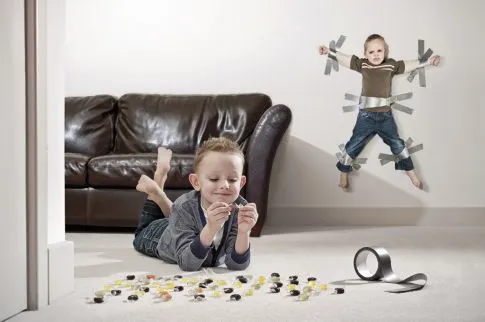
Restless children are children who are eternally punished, punishments pile up on them and they usually serve no purpose either. Use it only for what's truly important, otherwise you'll always be punishing them. With this type of child, punishing does little good.
- Avoid confrontations
By now, you'll already know at which moments your child may blow up. When they're very tired, when they're very happy about something, when there are a lot of people around… They are children who tend to be even more restless and nervous when they're with more people and tend to be calmer when they're alone.
If they're very tired or surrounded by people, avoid confrontations, be more permissive. These are not moments to educate, they are moments to contain. Be patient and be more flexible with their behavior.
- Don't criticize them in front of people
If you do, you'll open the floodgates. If I label my child in front of people, I'll make them notice them more. Picture a family meal, all the children playing before going into the restaurant and yours is the first one to climb the tree. Without thinking, you say "he just can't keep still, he always has to make a scene" and automatically you make everyone notice your child's bad behavior. If in the same situation you go up to your child, without drawing anyone's attention, you take them and bring them down from the tree, proposing an alternative and less dangerous activity, the incident will go unnoticed and no one will label your child.
It's very important not to belittle them in front of everyone because they will feel attacked and looked down on, and you'll achieve exactly the opposite of what you want, you'll make them defy you more and disobey you. An attacked child is a resentful child who fills up with anger and rage. When we feel rage, we don't feel like behaving well, quite the opposite, we feel like causing trouble.
- Organize their life.
Routine, routine and more routine. It will give them security to know what they have to do at each moment. They are disorganized by nature, which is why they will need a lot of help in this regard. Routine is necessary in childhood, knowing what is expected of them at each moment makes the path much easier for them. You can make a schedule with drawings in their room for each day of the week or write it on a board, in short, let each parent choose their own way.
- Play, play and play
Play is the best source of learning in childhood. Guide their play so that it is productive, so that they try to finish one thing before starting the next. Sit down to do puzzles, look for calm activities so that they also learn to relax, play with your child at the things they don't know how to play on their own.
- Teach them to self-regulate
Read stories or look for children's meditations to do with them before going to bed. They need their energy to stop, they need to learn to self-regulate. Do activities with them that help them in this regard, such as family yoga or relaxations or songs. It is highly recommended to do this type of activity at the end of the day, to encourage relaxation and help them fall asleep.
There is a very lovely book that teaches parents to meditate with their children
- Educate positively
For me, educating positively is using positive reinforcement much more than negative reinforcement. A positive reinforcement is when you tell your child how well they've done things, thereby showing them exactly what you want them to do and motivating them to feel like doing it well. When I tell them how happy I am with what they've done or achieved, I create a climate of well-being in which it's easier for them to keep behaving well.
Negative reinforcement could be, for example, a punishment. I tell my child that what they've done is wrong and that's why I punish them. I tell them what is wrong but not what would be right. On top of that I generate discomfort and frustration.
In very restless children, the likelihood of doing things wrong increases, and if we add to that their disobedience or "delayed obedience", the likelihood of being surrounded by negative reinforcements increases. They get punished at school, at home, in the dining hall,… Everyone tells them what they do wrong, but who tells them what they do right?
Use positive reinforcement whenever you can. It's not about rewarding their good behavior with toys, it's about telling them how good they are at this or how well they did that, so that they see that you value their effort over the result. Let them see the pride in your eyes for what they do and not just the anger and frustration over what they don't do.
- Show them your affection

They need to know that we are there, no matter what. That we support and value them. But above all that we love them always, when they behave well and when they behave badly too. Love is not conditional, it doesn't change depending on their behavior, it isn't sold or traded, it isn't used as emotional blackmail.
Don't label them with phrases like "you're bad" "you're hopeless" "you always end up making me angry". Better use phrases like "I'm proud of you for what you've done" "you behaved so well all afternoon, I don't understand what's wrong with you now, are you tired? shall we go home?"
Affection is shown with gestures and with words. Gestures are easy, kisses, hugs, caresses, with words we are less skilled.
Conclusions
If you've made it this far, it's very likely that your child is one of the very restless ones. I hope these techniques help you to have more harmony at home and to manage to help your child with what they need: self-regulation, organization and relaxation.
But not everything is bad in these children, they have lots of good things: lots of energy, lots of eagerness to do many things, they are very expressive about everything, enthusiastic, talkative, curious and fun. They just need a little help to be able to channel all that energy into wonderful things!
Does this resonate with you?
Our team can help. Write to us and we'll guide you with no obligation.