How can I help my child manage their emotions well?

Mireia Navarro Vera
Director and psychologist
COPC 10631
Contents
About two years ago, in one of the talks I give at schools, I asked them to ask the parents what topics they would like me to talk about and to give me a list. To my surprise, they asked me to talk about emotions. It was the first time this topic had come up in the lists. The thing is, as parents we are very worried about making sure our son or daughter behaves well, eats well, studies, respects adults, etc... but we do not pay much attention to whether they feel well.
Now there is starting to be a growing interest both from schools and parents in educating our children about emotions, and as Goleman said, "in most cases IQ seems to contribute only about 20% of the factors that determine success." Goleman, the father of the concept of emotional intelligence, argued that we have two brains, the one that thinks and the one that feels, and that the second is more decisive for success.
By this I do not mean that we should stop paying attention to everything else, not at all, because those are very important things too, but we must add EMOTION MANAGEMENT to the list. Because a child who feels well behaves well.
You may also be interested in our video that talks about this topic
Our generation did not have an education that focused on emotions, neither at school nor at home. Therefore, it is normal that we have certain problems with our own emotions and that we do not even know how to start helping our children in this respect.
Emotions are essential for our behavior and for our self-knowledge. Emotion prepares you for action.
Definition of emotion
An emotion is a psychophysiological reaction that appears in front of a stimulus that is important to me, a situation, a place, another person's reaction, etc...
On a psychological level, emotion alters attention and memory. On a physiological level, rapid responses are organized by activating the endocrine system and the autonomic nervous system, preparing to give a response.
They help us understand the world and ourselves.
Emotions are divided into:
- PRIMARY EMOTIONS are the ones we are born with. Their function is the survival of the species. They are happiness, anger, fear, sadness and disgust.
- SECONDARY EMOTIONS appear between the ages of 2 and 12. They involve self-esteem and the sense of justice. They are pride, shame, stress, jealousy, guilt and envy.
- AMBIGUOUS EMOTIONS appear around the age of 10. They help redirect actions. They are surprise, hope and compassion.
All emotions fulfill a function and although we often talk about positive and negative emotions, all emotions are good. The positive ones are those that make us feel good and the negative ones are those that make us feel bad and the ones with the worst reputation. However, their function is essential: sadness invites us to withdraw and to seek comfort, anger helps us defend ourselves and fear protects us from some danger.
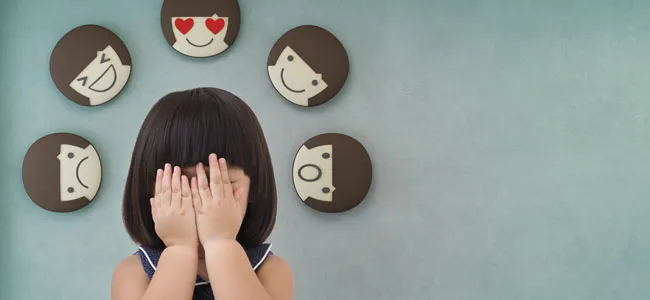
How do you manage an emotion well?
It is a good question. Because before teaching my son or my daughter to manage their emotions well, I should know exactly what a well-managed emotion is, right?
Well then, the first thing I should do is recognize that I am feeling an emotion and look at what it is. Give it a NAME.
"I am sad because I got some bad news at work." There I have it, SADNESS. Emotions are usually felt in the body, so a good exercise is to see where I am feeling it. Locate it IN THE BODY.
I do not fight against the emotion, I do not repress it, nor ignore it, nor get angry with myself for feeling it. I ACCEPT IT. And I allow myself to feel it.
And finally I LET IT GO. This is sometimes very complicated, especially with negative emotions. Many times I will need comfort from someone (for sadness) or some breathing technique (for anger).
If you think you need help managing your own emotions, I recommend the book "Lo bueno de tener un mal día" by Anabel González.
How to help my children manage their emotions well?
#### · Help them identify them
It is about GIVING IT A NAME. When your child gets angry because you are not staying longer at the park, you tell them "I understand that you are angry but we cannot stay any longer"
We can also use stories that talk about emotions. There are many and very good ones: The Color Monster, the big book of superpowers, and then there are books that work on specific emotions such as anger or fear.
Stories are the best way to teach young children to identify emotions. But not the only one. We can also ask them to tell us the thing of the day that made them happiest and the thing of the day that made them saddest. We help them reflect on what they feel during the day.
We must also help them locate it in the body. So that they connect more with the emotion they are feeling. We can even tell them to give it a color.
Close your eyes and tell me:
In what part of your body do you feel it? And what color is it?
#### · Encourage the expression of emotions
We are more educated to repress them. How many times have we been told, don't cry? And how many times have we caught ourselves saying the same thing to our children?
Emotions should not be repressed, they should be expressed, let them come out, let them flow. An emotion is born, grows, is expressed and disappears.
We must allow ourselves to feel it and we must also allow our children to do so. We should not judge them, punish them or cut them off. If our child has a tantrum and cries, I do not judge the tantrum and I do not punish it. I wait for it to pass, I give a name to what they have felt and the reason why they felt it and I help them self-regulate. You can see more about tantrums.
Another way to encourage the expression of emotions at home is precisely by expressing them, we are role models and if we speak freely about what we feel, our children will understand that this is something that can be talked about at home.
We should not demonize negative emotions "you are already grown up and you should not be afraid." As if feeling negative emotions were bad or a sign of immaturity or weakness. Emotions have a function and they are all good.
#### · Help them regulate them
While an emotion should be expressed and should not be repressed or cut off, it also cannot last a whole day. For example, the anger they feel for not having stayed playing in the park should not last all afternoon.
Children have difficulty self-regulating, because their brain is still immature and the prefrontal areas that are involved in the regulation of emotions have not developed. Therefore, our work here is important.
We can help them with breathing techniques, by suggesting fun activities to shift their focus of attention, with a hug.
Some examples:
SADNESS: a hug. Give them a hug or offer them a stuffed animal to hug.
ANGER AND RAGE: breathing. Breathe in until your little belly inflates, hold counting to three and let it out slowly. Suggesting an alternative game, especially one that involves moving.
FEAR: tell them about when you were also afraid. Accompany them, put a light in the room, etc...
If we help them regulate them, we foster the self-regulation they will have as an adult.
#### · Accept the emotion
We must accept what I feel, without judging it. We must listen to them because it is going to give us a lot of information about the world around us and about ourselves. Therefore, I am going to respect any emotion that my son or my daughter feels. Without making them feel bad about it.
Emotions are good and should be allowed at home. All of them, without exception. There are families where expressing sadness is not allowed, where you do not cry in front of others nor hug when someone is sad. Children quickly learn to hide this emotion when they feel it. And as adults they find it hard to connect with their sadness.
That is why it is important to let emotions be expressed and accepted, without exception. At home you are allowed to feel freely and say it out loud. No one will judge you for it nor make you feel bad or inferior or childish.
We talk about emotions when we watch movies, when we read stories, when something happens in the family that affects us and makes us feel emotions, etc... If I foster communication where emotions have a place, I am already giving permission for everyone to express what they feel.

Does this resonate with you?
Our team can help. Write to us and we'll guide you with no obligation.