Perception and attention in children with autism spectrum disorder (ASD)

Mireia Navarro Vera
Director and psychologist
COPC 10631
Not all children affected by autism spectrum disorder (ASD) display the same symptoms, but there are indeed certain more typical or frequent symptoms which, depending on the developmental stage, may occur in a transient or a chronic way.
Taking a brief look at the attentional and perceptual capacity of children with ASD, autism spectrum disorder is related to very specific characteristics of perceptual processing. The immense range of diversity encompassed by the disorder and the singular way in which they perceive the world is determined by the difficulties associated with the sensory channels.
Regarding perception, the autistic individual Dietmar Zöller states "Quien entiende porqué soy así y no me puedo comportar de otra forma, no me puede hacer ninguna injusticia más. De hecho, tiene razones para decir que destacamos o que desarrollamos hábitos extraños. Nuestros cerebros funcionan de forma diferente y por ello respondemos de forma tan peculiar".
Sight turns out to be one of the most developed senses along with smell. They possess a sharp photographic memory and, due to their hypersensitivity, their reactions may lead one to assume that they avoid emotional and communicative connection.
Children with ASD present difficulties when it comes to communicating and processing the information they receive from their environment or from a social interaction. Most children avoid eye contact in order not to receive a sensory information overload. Nevertheless, this is currently not a characteristic that can be defined as a generalizable diagnostic criterion.
On the other hand, it can be difficult to establish an interaction with a child with ASD given their auditory hypersensitivity, in some cases. They often avoid receiving an excess of information and this leads to an observed level of disconnection that is really high, which means that only part of the message ends up being internalized. This causes a clear impediment to the willingness to communicate with the people around them and, ultimately, their environment.
Attention in children with ASD
By attention we understand the capacity that allows us to select important information and maintain it until we reach our priority, as well as being a basic function in the development of learning and in various cognitive processes.
According to Sholberg and Mateer, in their hierarchical model of attention, children with a diagnosis of ASD show difficulties in focused and selective attention when we compare them with individuals of the same age, level of intelligence and linguistic development.
Regarding the processing of social stimuli and in situations where a social interaction is established, focused and selective attention in the child with ASD may present difficulties or inflexibility when compared with what is socially stipulated or considered correct.
We must place special emphasis on the fact that to understand the social interaction of children with ASD, joint attention will be a key factor.
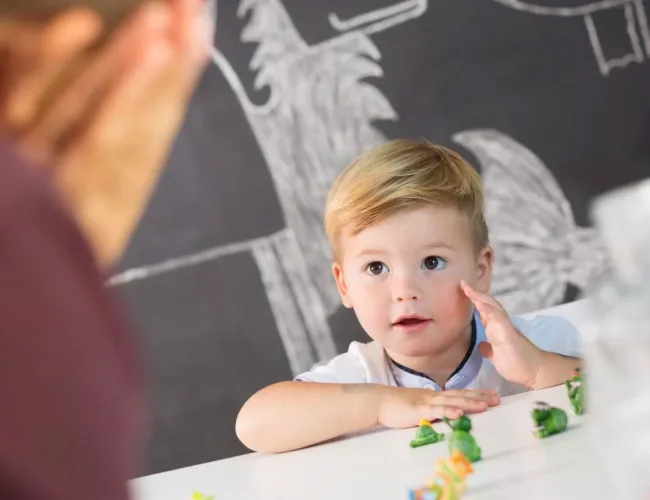
By joint attention we understand the ability to respond in the direction of another person's gaze with the aim of communicating and, in turn, the initiative on the part of the child in seeking the attention of their reference person (pointing, showing or eye contact).
A child with ASD may use certain pointing techniques or instrumentalization of the parental referent with the aim of obtaining the desired object and not for a social purpose, that is, it becomes more of an imperative action. This is usually a warning sign in the first 15 months of the child's life, when the child does not develop such joint attention, not using the direction of the gaze, sharing it between the desired object and the adult or reference person.
Nevertheless, joint attention may occur in later cognitive and/or linguistic development, especially at the level of oral comprehension.
How can we improve attention at home?
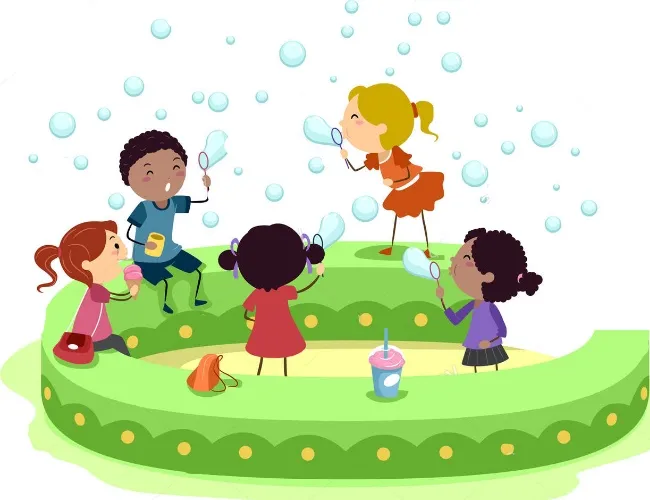
- Standing behind a cloth or sheet and calling them by their name. We can also make different sounds and wait for them to look at us. Once they look at us, we lower the sheet or cloth. One example can be peekaboo. This will also help us foster joint attention.- We can play at dressing up, putting on wigs, hats, glasses, etc., that capture their attention. In this way we can also work on the gradual approach to stimuli related to gestures and faces and maintain functional eye contact.- We can paint together. We can make a small sequence of 3 to 5 colors and, with our help, guide them in copying the model.- We can use soap bubbles or balloons. We inflate or blow them and repeat sequences such as "ready, set, go!" or "1, 2 and… 3!" It is important to wait for them to ask us to continue or repeat the action. Sometimes, when the child does not respond to their name, we can try to capture their attention from an angle where we cannot be seen directly, prompting their attention toward us. We work on joint attention again.- We can use small instruments and invite them to copy the sequence we have produced. For example, jingle bells, maracas, xylophone, tambourine…- In front of a mirror we can exaggerate different facial expressions through mime, and in this way we can also work on emotions. We can also exaggerate body mime and vary the tone of voice.
It is important that these activities are carried out at the child's level and positioned facing them. Do not overuse verbal language and use physical guidance more.
After the activity we can help bring it to a close by creating a relaxing environment. It can help us to read a story, take a bath, listen to music, give feather massages…
It is a time of play and of sharing moments with them, so we should enjoy it, not set ourselves unrealistic goals or objectives, we should not be demanding nor generate great expectations. The activities will be short and motivating, we should forget about expecting the child to remain with sustained attention for long periods of time, because we will end up frustrated.
We seek to spend a while and a quality experience rather than quantity, in which we will help to improve their attentional and perceptual capacity.
Does this resonate with you?
Our team can help. Write to us and we'll guide you with no obligation.