7 out of 10 children will be addicted to new technologies in adolescence. How to prevent it

Mireia Navarro Vera
Director and psychologist
COPC 10631
Contents
- Basic recommendations for good use of ICT:
- Take the child's age into account
- Time of use
- The tablet is not a babysitter
- Avoid technology in their bedrooms
- ICT as rewards or punishments
- Take an interest in what they do
- Give value to human relationships
- Solitary play vs shared play
- Restrict the use of portable consoles
- Knowing how to detect a possible addiction
- In summary: time together and dedication
According to Marc Masip of the Desconect@ Program, 77% of young people between 18 and 24 are addicted to new technologies.
Marc and Eva are a young couple of about 35 with two small children. They like to go out as a family and often go to eat at the same restaurant. It is a charming and quiet place; the baby falls asleep in the stroller and Erik is given the tablet to play and watch cartoons, while they chat with their friends, another family with a 4-year-old girl who also enjoys her favorite cartoons on her tablet. What is happening? Where do personal relationships go?
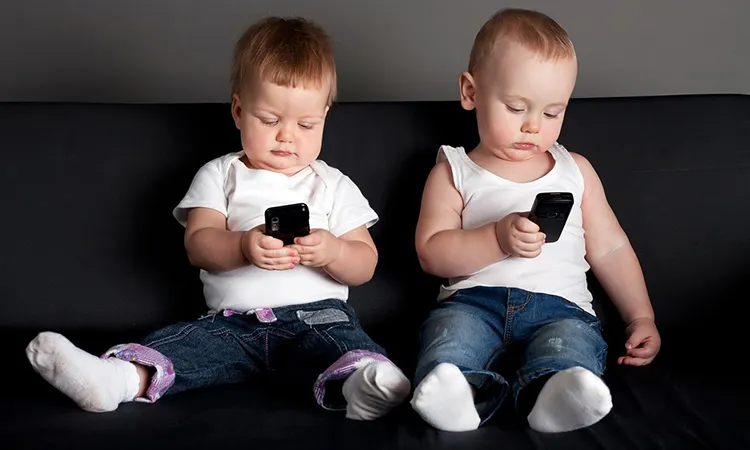
It is a very common sight to see families on terraces or in restaurants enjoying a moment together with the children immersed in their portable consoles or their tablets.
It is very easy for parents to keep the children entertained while they have a drink or do household chores. But it is a risk and I believe we must know how to make good use of new technologies, because, like everything in life, it has its good side and its bad side. It is not about demonizing their use, that would be unfair and unrealistic. The world moves with new technologies and our children must know how to use them. If we guide their learning, we can get a lot out of them; they have great potential and are part of our way of communicating with the world. A fast, simple and very powerful way.
Basic recommendations for good use of ICT:
Take the child's age into account
- We must take the child's age into account:
In children aged 0 to 2, the use of new technologies is discouraged (phones, tablet, TV, video games.). At this age the development of the brain is dizzying and is highly determined by the external stimulation the child receives. Excessive stimulation is as harmful as deficient stimulation. It has been shown that exposing them to such fast and powerful stimuli as new technologies is associated with attention deficit, cognitive delays, learning problems, impulsivity and a decreased ability to self-regulate. See
From the age of 3, guided use is recommended, that is, under supervision, but above all with the accompaniment of their parents. It is about sharing with them, playing together, not using the tablet as a babysitter. The goal of introducing children to the use of ICT at such an early age is none other than to take advantage of how receptive they are and how eager they are to share with their parents, in order to teach good use of these technologies. Studies such as the one by Guillermo Cánovas encourage us to take advantage of the opportunity to use these new technologies well with our children: How? By sitting down next to them!

If from a young age they get used to interacting with us in the use of new technologies, in adolescence it will be easier for us to continue interacting without them seeing it as an intrusion. If we have educated them in their good use when they are little, we will have gained a lot of ground when they grow up. We can also teach them to make much more of ICT and not use them just as mere entertainment.
Time of use
- Time of use.
There are studies that say two hours a day is already considered excessive. What I recommend is that you should never leave children without time to play more traditional games because they are essential for the child's proper development. Considering that nowadays, unfortunately, children have very little time to play, we must ensure that 80% of this time is spent on symbolic games (playing with toy kitchens, playing with toy cars, playing family or school class with dolls…), construction games, puzzles, painting and crafts.
The important thing is to agree on the time they will spend browsing the internet, watching TV or playing video games, especially with teenagers. There is time for everything: doing sports, going out with friends, reading, studying and doing other activities. We must ensure that our children dedicate time to everything and not too much time to anything, that is, not let their time be exclusively dedicated to the use of ICT.
The tablet is not a babysitter
- The tablet is not a babysitter

It should be one more tool to play and interact with our children. We should not constantly use it as a babysitter while we do other household chores, without any control over what they do or the time they spend. Excessive and solitary use could foster problems of isolation and addiction. ICT can have an educational function as long as parents are present in its use; otherwise its function becomes merely leisure and entertainment.
Avoid technology in their bedrooms
- Avoid the use of technology in their bedrooms
It is not advisable for our children to have a TV or video games in their bedrooms. Most experts recommend keeping the computer in a common area of the house. The reason is obvious: if it is in their bedrooms, the control parents can exercise is relative, and it also fosters isolation and poor family communication. If the TV, the computer, the console… are in a common area of the house, it will be necessary to negotiate which TV program we watch, how long we use the computer, or when to play and when not. It will facilitate communication and parental control, as well as family time.
ICT as rewards or punishments
- The use of ICT as rewards or punishments

It is very common to use them as rewards: "if you behave well I'll let you have the tablet" or as punishments: "you're grounded from browsing the internet for a week". Prohibiting their use will make them more desirable. Using them as exchange tools can be counterproductive because our children will do things in order to use ICT and once they get it they will stop trying. We do not teach good use, we give them more value than they have and, what is worse, we teach our children to do things in exchange for something. By this I do not mean that they should never be used as a reward or punishment; in situations related to ICT it will be effective to use it, for example if two siblings are fighting over the tablet, taking it away until they reach an agreement could be very effective. Another example would be allowing them to watch TV or play a video game after having done their daily responsibilities, as a moment of leisure and rest.
Take an interest in what they do
- Take an interest in what they do
Which games are their favorites? Which pages do they visit? Spending time with them while they use new technologies will give us information about their preferences and we can take the opportunity to point out which games are more educational, what stereotypes a certain website transmits, how to search for information, … Educate our children in their use and be very attentive to what they do when they are connected. Warn them of the dangers of posting certain things online and recommend more educational games.
Give value to human relationships
- Give value to human relationships
Virtual communication is a fact, but it should never replace face-to-face relationships. Foster good interpersonal relationships, encourage them to go out with their friends, not to relate solely and exclusively online. Teach by example, spending time together, time with other friends and family, so they learn to enjoy those moments too. Locking oneself away at home and relating only virtually can promote social phobia.
Solitary play vs shared play
- Solitary play vs shared play
Without a doubt the second option will be more advisable than the first. It fosters communication and becomes a support for social development. One modality that is being used a lot is online gaming. Playing online with your friends is a great option. Solitary play loses in terms of educational power, being only entertainment without any educational purpose. Video games should be appropriate for their age and it is better if they play with their family or friends.
Restrict the use of portable consoles
- Restrict the use of portable consoles

Portable game consoles make it easy for children to play anywhere and at any time. Their use during family gatherings, such as eating at a restaurant, should be restricted. Our children have to relate to others; it is the only way to learn to develop social skills.
All portable new technologies can promote our children not exposing themselves to situations of relating with others and isolating themselves.
We should also avoid the use of phones, tablets or game consoles during meals at home. All together at the table should be a moment of family communication; if we turn on the TV or if everyone is on their phone at the table, it is clear that we will not talk, at least not to each other.
Knowing how to detect a possible addiction
- Knowing how to detect a possible addiction
If you have noticed that your child spends too much time using ICT and is not really aware of how long they have been. If they appear more restless and irritable than normal, especially when they cannot use them. If they have stopped doing leisure activities they used to do in order to dedicate more time to ICT. If they neglect their responsibilities and their friends, it is likely that an addiction is developing. The best thing we can do if this happens is to talk with him/her about our concern and seek professional help.
In summary: time together and dedication
As you can see, there are no magic formulas; almost everything related to our children could be summed up in two words: time together and dedication.
Does this resonate with you?
Our team can help. Write to us and we'll guide you with no obligation.