
Definitive guide to social phobia in adolescents

Eugenia Olego Gual
Child, adolescent, and adult psychologist
COPC 16511
Contents
- What is social phobia in adolescents
- How to recognize social phobia
- Feared social environments:
- Differences between shyness and social phobia:
- Diagnosis of social phobia
- DSM-IV diagnostic criteria:
- Associated symptoms or disorders:
- Treatment of social phobia in adolescents
- Treatment of Social Phobia:
- Pharmacological Treatment:
- Conclusion
>
>
#### Even though she knew the answer perfectly well, Silvia lowered her head when the Physics teacher asked her in class. When she has to ask or answer in the middle of class she blushes, stutters and even goes blank. The only thing she fears is making a fool of herself and that everyone else will laugh at her. In Physical Education something similar has happened to her: she feels so watched that many times she has experienced symptoms of anxiety that have led her to faint. She is aware that the fear she has is excessive but she cannot control it. She makes up a thousand excuses not to go to class and not to go through this distress.
>
>
What is social phobia in adolescents
Most epidemiological studies place the age of onset of social phobia in adolescence, being very high between the ages of 14-16. It is estimated that social phobia occurs in 1 percent of children and adolescents. That is why it is important to detect those signs in which we see that the adolescent suffers from this phobia. For that reason we have prepared a guide to discover symptoms related to Social Phobia.
We define Social Phobia as a lasting fear of one or more social situations in which the person is exposed, or believes themselves to be exposed, to being observed by other people, automatically experiencing a pattern of anxiety responses that significantly interferes with social activity and entails intense suffering.
The child or adolescent with this type of phobia has a disproportionate fear of being judged or evaluated in situations with unfamiliar people. This leads them to fear and avoid relationships with peers and unknown people, while with familiar people there is a desire for contact and involvement.
##### This fear affects them in three ways:
- At a cognitive level: Their thoughts are related to the possibility of doing or saying something that makes them seem clumsy or foolish and that makes them look ridiculous in front of others. They usually anticipate what is going to happen with catastrophic consequences. For example: "everyone is going to laugh because I turned red"; "They are going to notice that I don't know it"; "They are going to see that I'm stuttering",..
- At a psychophysiological level: their mouth goes dry, sweating, a feeling of suffocation, excessive sweating, difficulty swallowing, trembling,…
- At a motor level: They tend to avoid the social situations they fear (they stop going to school, stop going out with friends especially in groups, stop going to football, stop attending dance,..). When they cannot escape from such situations their behaviors are defensive. For example, avoiding the gaze of their interlocutor when the latter speaks, looking for strategic places where they go unnoticed, speaking the bare minimum, etc.
How to recognize social phobia
Feared social environments:
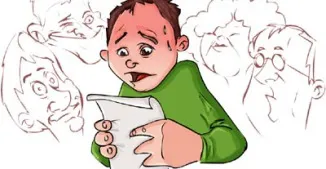
The social environments that adolescents with social phobia fear would be: giving a talk in class, entering competitions, being asked in class, playing an instrument in music class, eating in the bar or dining hall with others, calling a classmate to ask about homework or doubts, in the playground with large and even small groups, asking the teacher for help or clarifications, working on a group project, talking to authority figures, including the parents' friends, answering the phone; attending parties, dances, sports; situations that require assertiveness such as telling someone not to speak so loudly or to stop making jokes or to stop copying their homework; starting conversations with other adolescents especially of the opposite sex; ordering food in a restaurant,..
Differences between shyness and social phobia:
Usually social phobia is confused with shyness, but they are not the same. People who are shy may feel uncomfortable when they are with other people or have to speak in front of others; but they do not experience extreme anxiety when anticipating a social situation and do not necessarily avoid circumstances that make them feel self-conscious. In contrast, people with social phobia do not necessarily have to be shy. They may feel completely comfortable with other people most of the time, but in specific situations, such as giving a presentation or walking down a hallway with other people, they may feel intense anxiety. A point to highlight would be that social phobia interferes very significantly in the adolescent's life.
Shy people may turn red or tremble in situations such as giving a presentation, but they overcome it and do it; moreover, as they carry out the presentation, they feel more secure and their anxiety symptoms have been minimized or, simply, extinguished. However, the young person with social phobia tries to avoid doing the situation by "getting sick" or asking another classmate to do their part for them; and if they have to do it, they experience the symptoms we have mentioned in previous lines (at a cognitive, psychophysiological and motor level) with intense anxiety, even presenting a major situational panic attack. As we observe, this incapacitates the adolescent, whereas the shy person may be uncomfortable but it does not block them.
Diagnosis of social phobia
DSM-IV diagnostic criteria:
Below we will name the criteria that the adolescent must meet in order to diagnose the existence of a social phobia disorder. Said phobia is within the anxiety disorders.
- A marked and persistent fear of one or more social situations or public performances in which the subject is exposed to people who do not belong to the family circle or to possible evaluation by others. The individual fears acting in a way (or showing anxiety symptoms) that is humiliating or embarrassing. As for children, it is necessary to have shown that their capacities to relate socially with their relatives are normal and have always existed, and that the social anxiety appears in gatherings with individuals of their same age and not only in any relationship with an adult.
- Exposure to the feared social situations almost invariably provokes an immediate anxiety response, which may take the form of a situational panic attack or one more or less related to the situation. In children the anxiety may translate into crying, tantrums, inhibition or withdrawal in social situations where the attendees do not belong to the family setting.
- The individual recognizes that this fear is excessive or irrational; in children this recognition may be lacking.
- The feared social situations or public performances are avoided or else endured with intense anxiety or discomfort.
- The avoidance behaviors, the anxious anticipation or the discomfort that appears in the feared public situation(s) interfere markedly with the individual's normal routine, with their work (or academic) or social relationships, or else produce clinically significant discomfort.
- In individuals under 18 years of age the duration of the symptomatic picture must last at least 6 months.
- The fear or avoidance responses must not be due to the direct physiological effects of a substance (e.g. drugs or medications) or of a medical illness, and must not be better explained by the presence of another mental disorder such as, for example, panic disorder with or without agoraphobia, separation anxiety disorder, body dysmorphic disorder, pervasive developmental disorder or schizoid personality disorder.
- If there is a medical illness or another mental disorder, the fear described in the first criterion (A) must not be related to these processes. Thus, for example, the fear must not be due to stuttering, to the tremors of Parkinson's disease or to the display of abnormal eating behaviors in anorexia or bulimia nervosa.
Generalized: if the fears refer to most social situations (also consider the additional diagnosis of avoidant personality disorder).
Associated symptoms or disorders:
As for the associated symptoms and disorders, one of the serious problems of social phobia is the high rate of comorbidity it presents with other disorders. This is important since if there is the presence of comorbidity this increases the severity of the symptomatology and causes greater deterioration, increasing the suicide rate of these people.
The most common comorbid disorders are: other anxiety disorders (the most frequent ones associated with social phobia are agoraphobia and specific phobia; and the least frequent is obsessive-compulsive disorder), mood disorders and substance abuse; deficits in social skills, low self-esteem, difficulty being assertive and feelings of inferiority.
Many times one may think that, instead of facing a social phobia disorder, we are facing a mood disorder, major depression or dysthymia, since in social phobia there is a high degree of interference in personal relationships and it hinders the relationship with other people.
Many studies have pointed out the existing relationship between substance use and social phobia. In fact, in clinical practice it is common to hear some people afflicted with this disorder comment that in order to "help" overcome their shyness or their difficulties when they have to be with other people, they have "a few drinks", an anxiolytic or a toxic substance (marijuana, cocaine, etc.) to disinhibit themselves and appear more social.
Another problem associated with social phobia is low self-esteem. However, social phobia and self-esteem do not necessarily have to be linked. It is true that adolescents with social phobia frequently experience feelings of inferiority, although many times these are referred exclusively to the area of social competence (how I relate to others) and not to other domains, such as academic performance, functioning as a member of a family, performance of daily tasks or a sense of personal worth.
Treatment of social phobia in adolescents
Treatment of Social Phobia:
When there is suspicion of Social Phobia, examination by a specialist is recommended, who will carry out an exhaustive evaluation of the subject. After said process, treatment of the adolescent will be carried out.
The treatments that have demonstrated the greatest efficacy in the specific treatment of social phobia are those based on cognitive-behavioral procedures. This means that work is done on two basic levels:
- Cognitive Aspect: Work is done on the thoughts that people have about the situations that produce anxiety or fear in them and how they confront them.
- Behavioral Aspect: The behavior they carry out, what they do and what they don't in these situations
Techniques used:
Below we will name the techniques used in Social Phobia:
- Psychoeducation: It consists of presenting the general lines of the therapy and explaining the fundamental concepts that the adolescent with social phobia and their relatives need to know in order to set in motion the different components.
- Relaxation Training: a technique commonly used in the treatment of anxiety disorders which consists of training patients to control the level of physiological activation associated with the anxiety response. There are several types of relaxation; the most applied is Jacobson's progressive muscle relaxation:
The method is based on tensing and relaxing the different parts of the body voluntarily. At first the expert must indicate what to do and what type of sensations should be noticed. A comfortable posture must be adopted and the stimuli that may bother or distract should be reduced; finally the eyes must be closed for better concentration. This is the table of exercises to do when we tense and relax:
In order
Muscle groups
Tension and relaxation exercises
1st
Dominant hand and forearm
Clench (8-10 seconds) and relax the dominant fist
2nd
Dominant arm
Press (8-10 seconds) and relax the dominant elbow against the armchair arm
3rd
Non-dominant hand and forearm
Clench (8-10 seconds) and relax the non-dominant fist
4th
Non-dominant arm
Press (8-10 seconds) and relax the non-dominant elbow against the armchair arm
5th
Forehead
Raise the eyebrows (8-10 seconds) and relax them
6th
Eyes and nose
Squeeze the eyelids and wrinkle the nose (8-10 seconds) and relax them
7th
Mouth
Clench the teeth, the lips and the tongue against the palate (8-10 seconds) and relax them
8th
Neck
Push the chin against the chest and prevent it from touching (8-10 seconds) and relax it
9th
Shoulders, chest and back
Raise the shoulders upward trying to make the shoulder blades touch (8-10 seconds) and relax them
10th
Stomach
Tighten the stomach as if preparing to receive a blow to it (8-10 seconds) and relax it
11th
Dominant thigh
Press the dominant thigh against the armchair (8-10 seconds) and relax it
12th
Dominant leg
Bend the dominant foot's toes upward (8-10 seconds) and relax them
13th
Dominant foot
Bend the dominant foot's toes inward and curve the foot (8-10 seconds) and relax them
14th
Non-dominant thigh
Press the non-dominant thigh against the armchair (8-10 seconds) and relax it
15th
Non-dominant leg
Bend the non-dominant foot's toes upward (8-10 seconds) and relax them
16th
Non-dominant foot
Bend the non-dominant foot's toes inward to curve the foot (8-10 seconds) and relax them
- Exposure: This technique constitutes one of the essential components in the treatment of social phobia. It consists of exposing oneself systematically and gradually to the feared situations until being able to confront them with tolerable levels of anxiety. The exposure can be carried out in real situations, or by simulating the situations through role-playing techniques or behavior rehearsals, that is, representations that people make where they rehearse some of the sessions that produce fear in them and that they tend to avoid. It is also possible to carry out the exposure in the imagination. There are many works that prove that this technique is very effective for the treatment of social phobia; however, it seems that the maintenance of the therapeutic achievements may benefit from cognitive techniques.
- Cognitive restructuring: It consists of identifying and modifying those thoughts that maintain social phobia. The therapist identifies, challenges and combats the "erroneous" thoughts about each person's specific social situation. Finding alternative ways of thinking about what happens to us leads to less disturbing feelings and allows us to better confront these situations.
- Social Skills Training: Normally people who suffer from social phobia have a deficiency in their social skills. Although not all of them have a deficit in said skills.
- Relapse prevention: At this point we review what has been learned in the sessions and the success of them is evaluated.
The IAFS (Intervention in Adolescents with social phobia) is one of the multicomponent programs used in the treatment of social phobia. It consists of 12 group treatment sessions, lasting 90 minutes per session and held on a weekly basis. The components of the program are 4: Psychoeducation, Social Skills Training, Exposure and Cognitive Restructuring. The IAFS includes homework tasks with the aim of consolidating and generalizing contents.
Pharmacological Treatment:
The effects of pharmacological treatments in social phobia have been studied almost exclusively with the adult population; however, taking into account that for the biomedical model what matters is that the amount of the administered dose is effective, and not so much that it concerns children, adolescents or adults (so weight would be the most relevant variable) it can be said that the most effective pharmacological treatments in the treatment of Social Phobia are the MAOIs and the SSRIs. However, the high side effects entailed by the administration of MAOIs and the possibility of a hypertensive crisis prevent the administration of this medication without very strict monitoring.
Conclusion
We can conclude that this guide can help the parents and professionals of adolescents to detect possible symptoms that give rise to a social phobia, and thus, refer them to a professional who can advise them about social phobia disorder.
Does this resonate with you?
Our team can help. Write to us and we'll guide you with no obligation.