Which toys are most appropriate for my child?

Mireia Navarro Vera
Director and psychologist
COPC 10631
Christmas is approaching, and with it the time to think about what the Three Kings are going to bring our children.
Games gradually adapt to the stages of growth, and this is how children acquire the skills and abilities that correspond to their age.
For this reason, it is important to be clear about which toys are the most appropriate and suitable for each age.
Benefits of play
Games do not only entertain children but also generate countless benefits in them and stimulate cognitive abilities.
- Reasoning games: we teach them to observe, to ask themselves questions about things, and to make decisions autonomously.
- Creativity games: these are symbolic games where imagination, expression, and imitation are developed.
- Motor skill games: they acquire spatial vision, recognizing the environment, hand-eye coordination, and gross and fine motor skills.
- Cooperative games: they promote the learning of values and skills for social relationships.
Below we present the areas of development that should be stimulated and, at the same time, the most appropriate toys for that purpose.
Newborns
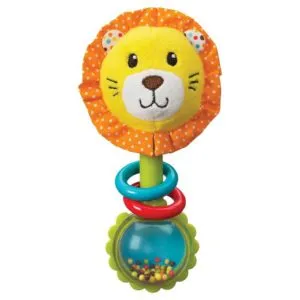
Babies are at an important time for their development, which is why it is important to develop skills in all areas in general.
It is important to develop and stimulate the visual areas, as well as the tactile, auditory, manipulation, and movement areas, among others.
The most appropriate toys would be:
- Rattles
- Small dolls
- Rolling objects
- Sound-making objects
- Multi-activity blankets
2-3 years
The most appropriate games when our child is 2 and 3 years old would be:
- Building blocks: they help to learn and distinguish colors and shapes and encourage manipulation and manual coordination, such as fitting toys and stacking cubes
- Books and stories: they help them develop language, acquire vocabulary, and express feelings.
- Clay and modeling dough: they encourage the development of fine psychomotor skills and creativity.
- Pencils and colors: they encourage fine psychomotor skills and imagination.
- Music: sounds help with auditory discrimination and imitation
- Symbolic play: garages, cars, dolls, doll strollers.
4 years
This is the age to mainly stimulate attention, memory, and cognitive abilities.
-
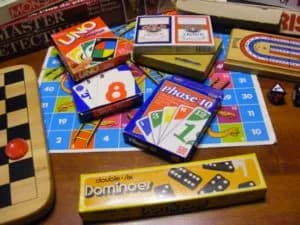
Board games**: they encourage shared play, respect for turns and the rules of the game, memory, and attention. Some examples would be memory games, cards, and dominoes.
- Building blocks: at this age, spatial relationships (up-down-right-left, near-far) and imagination are stimulated.
- Computers: they stimulate manual coordination and cognitive ability.
- Stories: they foster reading and the acquisition of vocabulary.
- Symbolic games: playing at cooking, at moms and dads, dress-up, and musical instruments, among others.
From 5 and 6 years old
This is the age at which children begin to play more with their peer group, which is why we recommend:
- Collective games: balls, sports that stimulate and help cooperation among the different members of the group.
- Games with rules: jump ropes, snakes and ladders, parcheesi, the lynx game, strategy games, concentration, experiment games
- Sports games: bicycles, roller skates..
- Creativity games: painting, modeling such as colors, clay, modeling dough
From 8-9 years old
We recommend:
- Games that stimulate creativity such as clay, modeling, jewelry-making, magic games
- Board games: memory games, chance, deduction, reasoning, questions and answers, strategy games, puzzles
Does this resonate with you?
Our team can help. Write to us and we'll guide you with no obligation.