What should I do if my child is afraid?

Mireia Navarro Vera
Director and psychologist
COPC 10631
Contents
All of us parents go through this stage at some point in our children's childhood. Fear is an emotion that is born with us and also grows with us, it matures and evolves at the same time as we mature. It is an adaptive emotion, it has saved us on many occasions from real dangers, and surely it served our ancestors on more than one occasion. But fear handled badly paralyzes us and does not let us move forward, neither adults nor children.
But today it's time to talk about childhood:
When should I worry about my child's fear?
Fears are normal. They should appear in our children. I should only worry if my child has many fears that cause them excessive distress or fears that are not appropriate for their age.
Fears according to the child's age:
At 9 months the fear of strangers usually appears. At first the baby goes with anyone; although they recognize their parents and relatives, they have no problem going into the arms of a stranger. From 9 months on, sometimes before or even sometimes after, this fear appears and our baby will cry if someone they don't know picks them up.
From 18 months on, the fear of separation appears. The child is afraid of being separated from their parents or attachment figures. This is when they make a fuss at daycare and kick and cry when they are separated from you. This fear lasts longer in some children than in others. The best thing is not to show anxiety when we leave them with someone, to speak to them calmly saying that we will come back to pick them up afterwards, and to say goodbye quickly. Sneaking out is not okay. It is a fear they have to face. In the end they will see that you always come back and they will understand that you are not going to disappear.

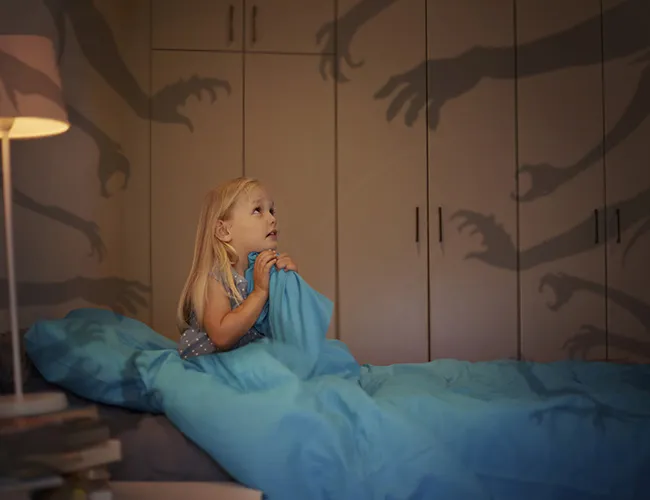
At 2-3 years old the fear of the wolf, of monsters, of darkness, of being left alone in their room will appear**. These are still unreal fears, full of fantasy and imagination.
From 7 years on, fears become more real, they are fears that could happen (a wolf is not going to come to our house but a burglar could…), they increasingly resemble an adult's fears. Fear that a burglar will break in, of natural catastrophes, of a fire,…. The fear of darkness and of being left alone also persists.
And as adults, you already know them, don't you? Fear of failure, of being left alone, of something happening to your loved ones…In short, we don't get rid of them.
What can I do to help my child?
1. Identify the fear, give it a name
Ask what they are afraid of. The aim is to identify the emotion and give it a name. What you feel is fear and we all have it, it's something normal. This is how we educate our children about emotions
And above all, listen without judging. Let them explain exactly what they are afraid of in full detail. Talk to them about fear as if it were something normal and tell them that we too are sometimes afraid.
Brave is not the one who has no fears, it is the one who, even having them, faces them
2. Don't give rational explanations
Fears are irrational. When you try to calm your child by saying:
"Don't be afraid, wolves can't come home, we live on the third floor in the middle of the city!! Wolves don't climb up windows and they don't live in cities, not even in the nearest mountains"
This is no use at all, because in their imagination wolves fly and come in through the windows and monsters exist and are under their bed.
If rational explanations don't even work for us as adults, imagine for children!
Better give them an imaginative solution or even better, ask them:
"how do you think we could get rid of that wolf?"
Their own solution will be the one that works no matter how useless it may seem, especially if we tell them:
"what a good idea you've had! It's sure to work".
3. Help them with a story
There is no better form of communication in childhood than stories. With them children learn to manage their emotions and find solutions to face their fears.
Here I leave you a selection of the best stories according to our children's age:
From 0 to 5 years:
Fear of darkness:
From 6 years on:
4. Talk to them about your fears
If you tell them that you too had some fears when you were little and you talk about them naturally, they will understand that being afraid is something normal, that they are no worse than others for having them. In addition, you can explain to them how you overcame that fear you had at 8 years old, it can serve as an example for them.
Talking about fear at home transmits to them that the family is the best place to talk about what scares us, that they can talk about the good but also the bad, that no one will judge them, a place where they can feel understood and protected.
5. Accompany them so they don't face it alone
If they are afraid to go to the bathroom alone, don't force them to do it, even though you know that fear has to be faced. At first, you will have to accompany them and keep encouraging them so they dare to go alone.
" Come on, I'll go with you and when you feel more confident, I'll wait for you outside"
Once this is overcome, we will accompany them to the hallway and so on until they feel strong enough to go completely alone.
If they are afraid of the dark, we can buy a lucky flashlight together, which they will keep very close to their bed and turn on to combat their fear.
The idea is that they feel supported by us and not ridiculed.
Does this resonate with you?
Our team can help. Write to us and we'll guide you with no obligation.