Symptoms of anxiety

Mireia Navarro Vera
Director and psychologist
COPC 10631
Contents
Questions and answers about anxiety
What is anxiety?
Anxiety is nothing more than a response of our autonomic nervous system to situations that are perceived as dangerous or threatening. Therefore, it is an adaptive response that has helped us preserve our species from the dangers of the environment for thousands of years.
Anxiety has a clear function: to warn and activate the organism in risk situations, so that we are prepared to give the best response to a threat. This response may be one of attack, flight, avoidance, search for safety, or submission.
The anxiety response is composed of three aspects:
- Cognitive: threatening anticipations, risk assessments, negative automatic thoughts, images, etc.
- Physiological: activation of various nerve centers, particularly the autonomic nervous system, which involves vascular, respiratory changes, etc. Responsible for palpitations, sweating, trembling,…
- Motor and behavioral: motor inhibition or overactivation, defensive behavior, search for safety, avoidant behavior, submission or aggressiveness.
What is clear is that it is a necessary response for the proper functioning of the individual; thanks to it we avoid dangerous situations or places, we try not to be late for work, we face up to different conflicts, we prepare for an exam, etc. In fact, in order to perform well, a certain state of alertness or psychological and physiological activation is necessary.
There are many researchers who have studied the relationship between the level of psychophysiological activation of the organism and the individual's ability to function efficiently. In general, it is considered that the best performance is achieved with medium levels of activation.
When is anxiety considered a problem?
Anxiety would be considered a disorder when the response reaches very high levels in situations with very little threatening content. Either because the person interprets neutral situations as dangerous or because their response to low-threat situations is very high. Their level of activation is such that it interferes with the personal, social, and work life of the individual and limits their freedom of movement and personal options. Generating suffering and incapacitation.
Within anxiety disorders, we find different subtypes that will largely determine the type of treatment that should be used for it to be effective. More information about our anxiety therapy in Santa Coloma
According to the DSM IV TR they are:
- Panic disorder with agoraphobia.
- Panic disorder without agoraphobia.
- Agoraphobia (without panic disorder). This would be a phobia of places where escape may be difficult or where it would be impossible to find help.
- Specific phobia (animals, flying, swimming, blood, the dentist..)
- Social phobia (anxiety in social situations or public performances)
- Obsessive-compulsive disorder (appearance of obsessions and/or compulsions)
- Post-traumatic stress disorder (anxiety and re-experiencing of highly traumatic events)
- Acute stress disorder.
- Generalized anxiety disorder.
What symptoms does anxiety have?
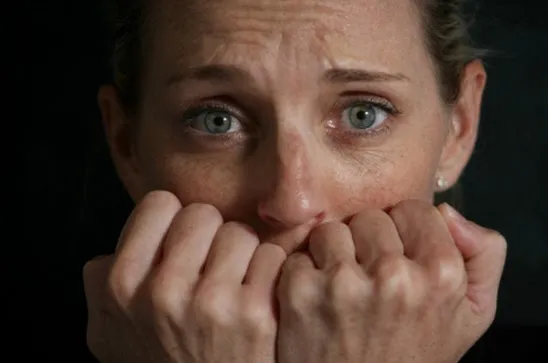
Anxiety appears with a feeling of fear or intense discomfort and is usually accompanied by physical symptoms such as:
1. Palpitations
2. Sweating
3. Trembling
4. Feeling of suffocation
5. Feeling of choking
6. Chest tightness
7. Nausea
8. Unsteadiness, dizziness or fainting
9. Tingling sensation in arms or legs
10. Chills or hot flushes
11. Headaches
12. Muscle tension
13. Insomnia
They do not all necessarily occur, far from it; in fact, each person has some symptoms that appear more than others and symptoms they have never had.
Along with these physical symptoms, psychological symptoms also usually appear, such as:
1. Restlessness
2. Feeling of overwhelm
3. Feeling of threat or danger
4. Urge to flee or attack
5. Insecurity
6. Feeling of emptiness
7. Derealization (feeling of unreality)
8. Depersonalization (feeling of being separated from oneself)
9. Fear of losing control or going crazy
10. Difficulty making decisions
11. Fear of dying
12. Impatience
13. Inability to relax
14. Feelings of inferiority
Behavioral symptoms also appear:
1. Avoidance of feared situations
2. Smoking, eating or drinking in excess
3. Restlessness (repetitive movements, scratching, touching,…)
4. Going from one place to another without a specific purpose
5. Crying
6. Becoming paralyzed..
The prevalence of anxiety disorders is high, being one of the most frequent disorders in psychology centers. Many are those who ask for help and many are those who suffer these symptoms without knowing that what they have is an anxiety disorder, and they get by as best they can, enduring, in better and worse periods, very high levels of anxiety.
If an anxiety disorder is diagnosed in time, the treatment is much shorter and more effective.
The problem arises when people come to therapy with symptoms that started many years ago and that now make it impossible for them to lead a normal life in many respects. This is where the treatment will be longer and more complicated.
Do all people with this disorder suffer anxiety attacks?
No, not everyone suffers anxiety attacks, although they are quite frequent. An anxiety attack is very striking and generates great discomfort. The general characteristic is the abrupt and temporary appearance of intense fear or discomfort, reaching its maximum expression in about ten minutes. The person suffers at least 4 of the symptoms described above and, above all, has a feeling of danger or imminent death and an urgent need to escape.
What can we do to calm down?
1. Practice deep breathing: it is very common for a person having an anxiety attack to hyperventilate. Breathe deeply, so that the air does not fill your lungs but your belly, and then exhale the air slowly until you run out of breath. These breaths should not exceed 8 per minute.
2. Use distractions: Count from 100 to 0 by 3s or recite your favorite poem. It will be very effective especially when there are negative thoughts feeding your anxiety.
3. Practice progressive muscle relaxation: It is a relaxation technique that consists of tensing and relaxing each muscle group of your body. Hold the tension for 10 seconds and then relax, paying attention to the sensations in your body. Start with the hands, the arms, the feet, the thighs, the buttocks, the neck, the forehead, the jaw …
4. STOP: try to stop the thoughts that produce anxiety in you and replace them with thoughts of things that bring you peace and tranquility.
5. Use guided imagery: It is another relaxation technique that consists of thinking of a place that makes you feel relaxed; it can be your home, the beach, or being in the arms of a person, whatever it may be. You must imagine the scene vividly, with all its details: smells, sounds, colors, sensations,…
6. Write down your feelings: Write what you feel, what you fear, and why you think you feel the anxiety. It will help you distract your attention and analyze your anxiety.
7. Do something: Distract your body and mind with something: clean, listen to music, draw, call a friend, do anything that keeps you busy and that makes you enjoy yourself
8. Include physical exercise in your life: gentle physical exercise will help you relax a lot: walking, doing yoga, swimming,…it will release endorphins that will make you feel much better.
9. Consult a psychologist: It is, without a doubt, the best option when suffering from an anxiety disorder. They will teach you to relax, will teach you to use the relaxation techniques described above, to distract your thoughts and, most importantly, to control your anxiety.
Can children have anxiety?
Studies show prevalence rates of anxiety disorders in childhood of between 8.9% and 15.4%, based on the combination of diagnoses.
Fears constitute an almost constant factor in the course of human development. The appearance of anxiety in children, far from constituting a pathological trait, indicates an evolution in which we can observe the awareness that the child is acquiring about their own individuality, their limits, and their resources. The recording of what may be dangerous is a fundamental developmental acquisition.
As happens with adults, anxiety here also has its function. The appearance of fears in childhood is normal: from 6 to 18 months fears of darkness and the unknown appear, separation anxiety also appears (around 8 months). In the second childhood, fears of animals (wolf), monsters, ghosts, loneliness appear…
From the age of 7, they begin to resemble adult fears more, fears about school and sports performance, fear of death, of thieves,…
But these fears disappear as the child develops and the child's level of suffering is normal.
When is my child's anxiety or fear not normal?
When the fear lasts longer than normal and is much more intense. When the fear is maladaptive: the child suffers, cries a lot, becomes paralyzed, avoids. When they stop doing the things they like, such as going to the park with their friends because there is a dog. Developmental fears pass; they are afraid of the dark, but if you accompany them or give them a flashlight that they can turn on at night, in a few days it disappears.
We say that a child has an anxiety disorder when the manifestations of anxiety are very intense and interfere with the normal development of their life.
If your child avoids situations they like because of their fear, freezes, cries, or feels great discomfort, it is very likely that they have an anxiety disorder. But the best thing, as always, is to go to a specialist.
Anxiety disorders in childhood are classified like adult disorders; the difference is that the symptoms are more somatic (headaches and stomachaches) and more crying, tantrums, and inhibition usually appear. There is one anxiety disorder that is specific to childhood:
Separation anxiety disorder: the main characteristic of this disorder is excessive anxiety linked to being away from home or from those people to whom the child is attached (father, mother, grandparents,..). Childhood anxiety disorders
If you think you have any of the anxiety symptoms described or your child could have some anxiety disorder, do not hesitate to get in touch with a specialist. Sometimes the solution is much closer than we think and we have much less to lose than we can end up gaining.
Does this resonate with you?
Our team can help. Write to us and we'll guide you with no obligation.