Discover the most frequent crises of a stable couple relationship

Mireia Navarro Vera
Director and psychologist
COPC 10631
Contents
Romantic movies and love songs are beautiful, but they don't tell the whole truth. They usually talk only about two phases: the one of falling in love or the one of breakup and despair. It would be quite unappealing for a Hollywood script to explain the day to day of a couple that has been together for 10 or 20 years and who no longer spend the day gazing dreamily at each other.
But in real life, the vast majority is what we look for, a stable couple relationship, starting a family…
Although we go into it poorly prepared. Nobody explains it to us and the movies confuse us even more, if that's possible.
A couple relationship is something that is in constant evolution, it grows with us, goes through crises like we do, matures, ages and changes. It necessarily must change because if it doesn't, it will disappear.
And changes are often preceded by crises. Personal crises, couple crises, work crises, existential crises, etc…
We have all had doubts about love at some point, doubts about whether to stay in a couple relationship or not. And this does not necessarily mean that it has to end. A stable relationship requires dedication, it is like a garden that needs fertilizer, care and water.
However, even though it is something so common, many of us are not prepared to feel these doubts about love and we usually have a very hard time. Does this mean that this is not the right person for me? Should we break up, even though everything has gone well so far?
Rushing is not good, you have to know how to wait for the answer: "neither before nor after, everything arrives exactly when it has to arrive"
Now we know that doubts and crises can be normal in a stable couple relationship. We will look at the most frequent ones:
The end of falling in love
Love is not in the heart, it is in the brain and specifically in the caudate nucleus (basal ganglia) and in the ventral tegmental area. The caudate nucleus is in the deepest part of our brain, the oldest one.
Helen Fisher a prestigious anthropologist from the USA who has dedicated years of her career to studying falling in love discovered where it is located and how it works:
*"When I first saw the images of the brain in love with the active regions lit up in bright yellow and orange I felt an overwhelming admiration. I have seen the blood flow activity in those areas and verified the chemical substances. There are two very active regions: the caudate nucleus, a primitive C-shaped region recently discovered and related to the brain's reward system, sexual arousal, sensations of pleasure and the motivation to obtain rewards. The other is the ventral tegmental area, VTA, the mother lode of the cells that produce dopamine.

Dopamine in large amounts, in addition to increasing the level of testosterone - the hormone of sexual desire -, is associated with a great capacity for concentration, euphoria and dependence, which are symptoms of addiction"*
So the phase of falling in love is a kind of addiction to the loved person. We are only well when we are with him/her. We lose our appetite, we feel euphoria and we obsess over the loved one. This state cannot last long, because then our species would be at risk of extinction. If our ancestors had been in love for long periods of time they would have been devoured by lions on more than one occasion.
This phase usually lasts between 6 months and 1 year. And then what? Well, right here, at the end of this phase, is where most breakups happen. The couple can move on to a more realistic love and a calmer one where the loved being stops being idealized and we see both their virtues and their defects. Or the couple can suffer a breakup.
Upon reaching this point, many people think, if I have already lost the magic and we have only been together for a year (or two years), what will happen when we have been together for 20? And they don't understand that a relationship is in continuous movement, that it changes, evolves and goes through crises. It can also end, of course, it is an option as valid as any other, the love may end.
Living together and commitment
After four years of relationship (or at three or five years, it depends on each relationship) the need to move to the next level appears. To commitment. And here we again question many things. It may be that both reach this point with the same commitment and want to start living together, but it can also happen that the level of commitment is not the same.
There will be couples who go to live together but there will also be couples who separate.
Living together is not so simple, without realizing it, we are going to form a whole network of implicit rules that will guide our future behaviors. Who takes care of one thing and another. What we eat, how we organize ourselves, what rules we follow and what rules we skip, etc…
Sometimes this will form on its own, without great difficulties but other times it won't. It will depend on the level of commitment of the two and on the functionality of the couple. If they are capable of forming a team, they will win the match. It is of no use to me that all my players are forwards, I need forwards and defenders. If you are good at scoring goals be a forward and don't criticize your partner because it's always you who has to score the goals, in the end the sum of the two is what makes you win a match.
The birth of children
Another great moment for the couple. We will go from being just two, from dedicating ourselves to each other and to ourselves, to being three or four (if twins come). Our roles are going to change, now in addition we are going to be parents.
This is a complicated phase. Therefore, if it occurs to someone to go looking for a baby to solve the couple's problems, let them think twice. Having a child is a trial by fire for the relationship and not everyone passes it.
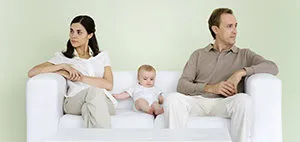
The first months you don't have time for anything, the situation overwhelms you and the sleepless nights drive you crazy. We are irritable and tired and here the reproaches begin.
It seems like a pessimistic view of the situation, it's not that there are only bad things, it's that those are the ones I have highlighted. It is also true that it is a very beautiful, magical and unique moment. Something you will remember for the rest of your life.
But if the couple relationship reaches this moment weak or limping, it will suffer the consequences. This is a moment where a large number of breakups occur.
And the thing is that at this stage the couple is relegated to the background, because the main role to take on is that of parents. Children become the priority. Sometimes there are disagreements about the parenting model. In other cases one of the two comes to feel that so much responsibility overwhelms them. It is likely that the impossibility of processing those conflicts leads to a breakup. If they manage to overcome these difficulties, the couple will become a family in addition to a couple.
What can help us overcome this stage?
- Flexibility, understanding the couple as something in movement that changes according to the needs of the moment.
- Not clinging to the past. There are people who demand the attention of their partner just as it was before and they don't understand that from now on this is going to change.
- As far as possible, not totally neglecting the couple relationship. Taking on the role of father or mother does not mean not being anything else. If I throw myself into parenting and stop taking care of my relationship, it will die. If you stop watering a garden, what happens?
- Forming a team. Understanding that we are both in this same boat, the boat of parenthood and that if we collaborate everything will go much better
- Communicating well. Talking about what we feel, about the changes, about what we need. It is not the same to say: "since "Elena" was born I miss you a lot, I would love to be with you more" as to say "I'm fed up with this crybaby girl who doesn't even leave us time to breathe".
- Time as a couple. The pediatrician should prescribe it at the first visit of our baby. Go out to dinner with your partner and leave your child for a couple of hours with grandma. And as the child grows, at each pediatrician's check-up let the dose increase, each time a little more time as a couple.
I am attracted to another person
When monotony sets in, it is easy that at some point we feel attracted to another person. It does not have to be the end of our stable relationship, it can be just an obstacle to overcome. Once again our tolerance for flexibility may help us get through this moment.

There are people who, as soon as they feel a doubt, already pass sentence on the relationship, "if I feel something for another person it means I no longer love them" and they may end a relationship before its time. If we have patience, in the end things fall into place on their own. If it is true that love is ending I will see it, I don't have to rush. But we manage very badly in uncertainty.
Sometimes what attracts us is not really another person, sometimes it is more a desire to feel that phase of falling in love again. Deep down, we are all a little addicted to love.
A couple relationship is like a garden, stop watering it and you will see that it soon dies, stop taking care of it and you will see that it soon fills with weeds. That is why it is important, in a stable relationship of several years, to dedicate a little time to each other.
What can we do?
Don't make rushed decisions, allow enough time to understand what is happening to you. Maybe it is just a weed in the garden that you will end up pulling out, or maybe it is a symptom of something more. But if we don't rush, surely we will be able to make better decisions.
Take care of your couple relationship if you want it to last and to be beautiful.
Analyze what attracts you about this new person, sometimes it is exactly the same thing that attracted you about your current partner, sometimes it is just what you miss from the beginning of your relationship. If so, what is probably happening to you is that you feel nostalgia for the past, for that relationship you had at the beginning. What you can do is look for those moments from the past to bring them into the present, such as for example going to that hotel where the proposal happened or playing that song that means so much to both of you. It is important to recall those moments to remember what unites us.
If in the end, this attraction comes to nothing, continue with your relationship and give it the importance it has. It is not easy to achieve a healthy and stable couple relationship, that is why you have to value it. If on the contrary that attraction is a symptom of something more and the love is ending, there is nothing wrong with leaving your healthy and stable couple relationship and starting another relationship. But remember that that person was important in your life once, don't treat them with hatred, allow the relationship to transform and go from being a loving relationship to a relationship of respect and affection.
The empty nest. Do we know each other from somewhere?
When the children leave home it is another of the important moments in any relationship. We have been parents for 20 or 30 years and now we stop being parents to be a couple again. Suddenly, we find ourselves sitting facing each other after so many years and we don't recognize each other. We have free time again to be together, but we don't remember what we used to do when we didn't have children.

We have to reinvent ourselves. Our couple relationship must adapt to this new situation. For some it will be easier than for others. It will be easier in those couples who during parenting have maintained individual and couple leisure activities, relationships with friends etc…
For the couples who have thrown themselves a lot into motherhood-fatherhood, it will be a little more complicated, but not impossible. They will have to look for new ways to spend time both together and separately.
What can we do?
It can be useful to sign up for dance classes together or for some hiking group to start doing new activities as a couple.
We must rediscover the pleasure of spending time as a couple, going out to dinner, visiting some little village…
We must also respect spaces of individuality, respect that my partner does something alone. We don't need to do everything together, because we won't like exactly the same things.
There is an exercise that I particularly like which is to put together the album of memories, of those endearing things we have shared throughout so many years of relationship. It will help us value what we have and what we have built together.
Conclusions
As I usually say in therapy sessions: "the couple relationship is like a garden, you stop watering it and you'll see what happens"
Take care of your relationship if you want it to overcome these and other moments of crisis that will surely appear. If the relationship is strong and well consolidated, it will withstand them and will come out reinforced from each of the crises.
Be flexible, life is in constant change and therefore relationships must adapt and they necessarily must change in form, in intensity, in color or in whatever, but change. A rigid and inflexible relationship will not overcome any crisis, a relationship that tries to have exactly the same as it had before being parents and clings to the past, will not be able to evolve and will tend to break.
Spend time as a couple, even if sometimes it's more and sometimes less, may it never become zero.

Does this resonate with you?
Our team can help. Write to us and we'll guide you with no obligation.