How can we help our child when they have aggressive behaviors?

Mireia Navarro Vera
Director and psychologist
COPC 10631
Contents
Aggressiveness is a normal behavior in human conduct since it serves the function of defending and protecting us.
At early ages, these behaviors are completely normal; they are generally due to the fact that children do not know how to resolve conflicts, do not yet know how to express themselves, and by nature children of young ages are egocentric. That is why there is no need to worry at all.
On the other hand, at later ages, aggressiveness becomes a response that hinders relationships with others when it occurs and can give rise to social and school maladjustments. That is when we should be more concerned.
The most advisable thing is to try to prevent this problem quickly and effectively so that it does not become more serious at later ages.
Aggressive children tend to have problems relating to other children and adults and adapting to their closest environment.
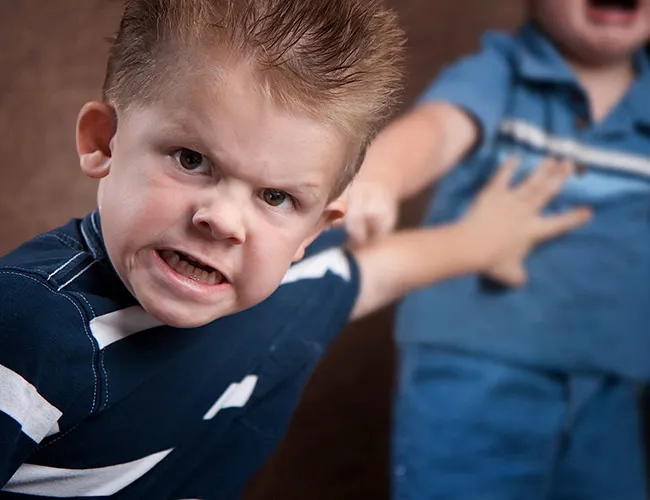
Aggressiveness can be expressed in a verbal way such as insulting or physically such as hitting, kicking, pushing, but it can also be in a more indirect way, that is, breaking objects or damaging the belongings of the person they want to harm.
Some of the causes of aggressiveness
Aggressiveness is a form of expression that can be a consequence of personal conflicts, such as seeking adults' attention or having the goal of obtaining something, among others.
- Aggressive behaviors can be learned by imitation, whether from the parents themselves or schoolmates. Authoritarian parents or very undemanding parents can give rise to and foster aggressive behavior in their child.
- At the same time, since parents are the models and examples for their children, it must be taken into account that if parents punish their child with aggressive behaviors, it is likely that the child will learn to carry out these behaviors. For this reason, physical punishment should be avoided.
- Sometimes difficulties in expressing themselves correctly can also be a cause of aggressiveness since it is the only means they find to channel what they feel. Let's help them find the words that express their emotion!
- Difficulties in social skills and difficulties in resolving certain situations
- On television, video games, and the media, countless aggressive images are seen
General guidance
- Do not watch violent scenes alone, whether on television, in video games, etc., and instead carry out shared activities or extracurricular activities.

- The family has to be a correct educational model and we must set an example of how to resolve conflicts through words and never resort to aggression, whether verbal or physical.
- Teach them alternative methods to conflict and to problem-solving, that is, not only telling them "you must not hit" but indicating what they have to do to solve the problem.
- We can take the child out of the context where the behavior is occurring so that they can calm down and analyze what has happened and thus look for alternative solutions
- Praise peaceful behaviors and each time our child resolves situations calmly and appropriately.
Activities to foster self-control and patience:
- Crafts: making crafts fosters patience since they are an entertaining task but must be done little by little.
- Caring for plants and pets, these activities foster responsibility in minors.
- Doing team sports and extracurricular activities, since they foster taking turns among the different members, respecting one another, and solving the problems that arise.
Aggressive conduct and behaviors are learned and therefore can be modified and redirected, which is why prevention is very important, that is, the family and the adults who surround them.
Does this resonate with you?
Our team can help. Write to us and we'll guide you with no obligation.