Children Can Also Help Out

Eugenia Olego Gual
Child, adolescent, and adult psychologist
COPC 16511
Contents
Why children should help out at home
One of the essential aspects of a child's autonomy is the early contribution of household chores at home. If we start these activities at an early age, we will minimize problems during adolescence, since at that stage they tend not to want to do many things; but if they are used to it, these difficulties will not arise as much.
By implementing tasks, we will teach them to be more responsible in the future and to better appreciate the effort behind everyday things.
Benefits of involving children in household chores
Some of the benefits they gain from being involved in household chores would be:
- Development of balance, organization and visuomotor coordination: Tidying up their toys, setting the table in a particular way or getting dressed are activities that help foster these motor skills.

It is observed that children who take on household chores from a very young age are tidier and more organized than the rest.
- They will improve their self-esteem: The fact that their parents involve them in tasks makes the child see that their parents trust him. And this leads to a good sense of self-confidence.
- Learning to work as a team: By taking part in household tasks, we make them part of a team, and this will help them learn to work better in a group.
- Facilitating the establishment of routines. We already know that routines are very important in children's lives, since besides organizing themselves better, they feel more secure. In addition, they have better academic performance because their logical thinking is more developed and also because they are already used to having to be responsible for any proposed activity.
- Solidarity. They learn that household chores must be done by all members of the family; therefore, it is essential that both parents also help out.
How to involve them without arguments
HOW TO INVOLVE THEM WITHOUT ARGUMENTS:
Ideally, we should involve them in tasks in a natural and playful way so that they do them without feeling forced to.
- Doing it like a game so that they find it fun and stimulating.
- Reinforcing them in a positive way so that they feel satisfied with what they are doing.
- Explaining the task as simply as possible so that they can understand it without feeling frustrated, because if that happens they will not want to do it. That is why we need to arm ourselves with patience.
Household responsibilities by age
Household responsibilities by age:
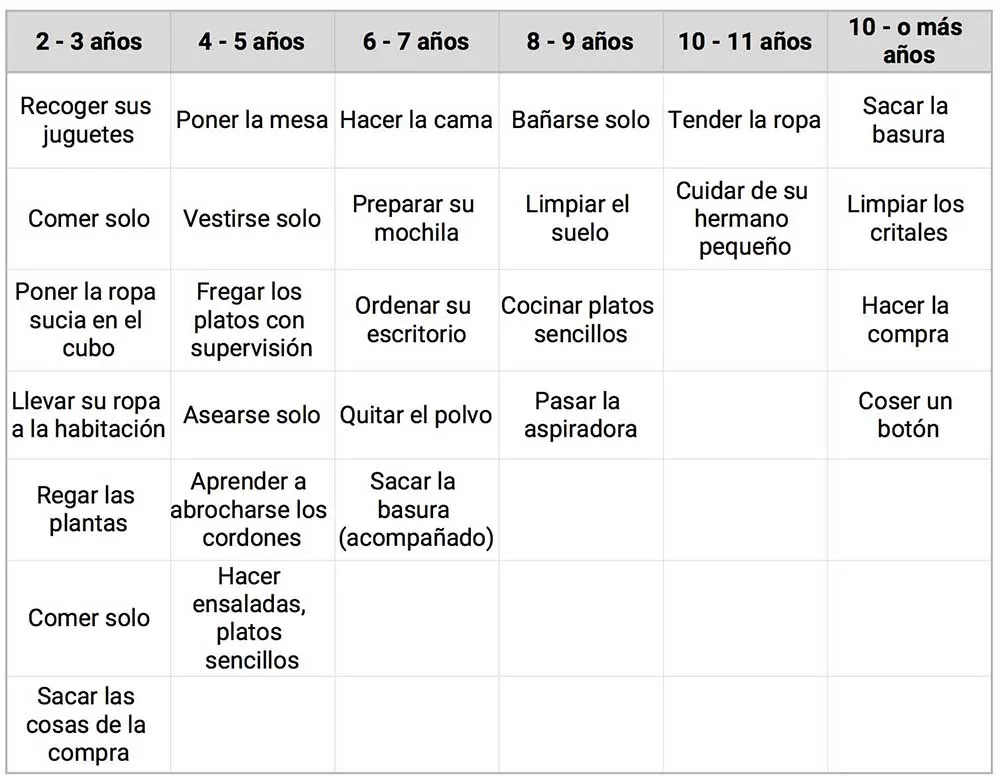
Many parents are surprised when we show them this table, but the truth is that children are capable of doing more than we ever imagine.
Here we show some of the tasks they can do, broken down by age:
Taking on tasks early will allow us to teach them to be more responsible, very autonomous, will help them make better decisions in life and improve their self-confidence.
Does this resonate with you?
Our team can help. Write to us and we'll guide you with no obligation.